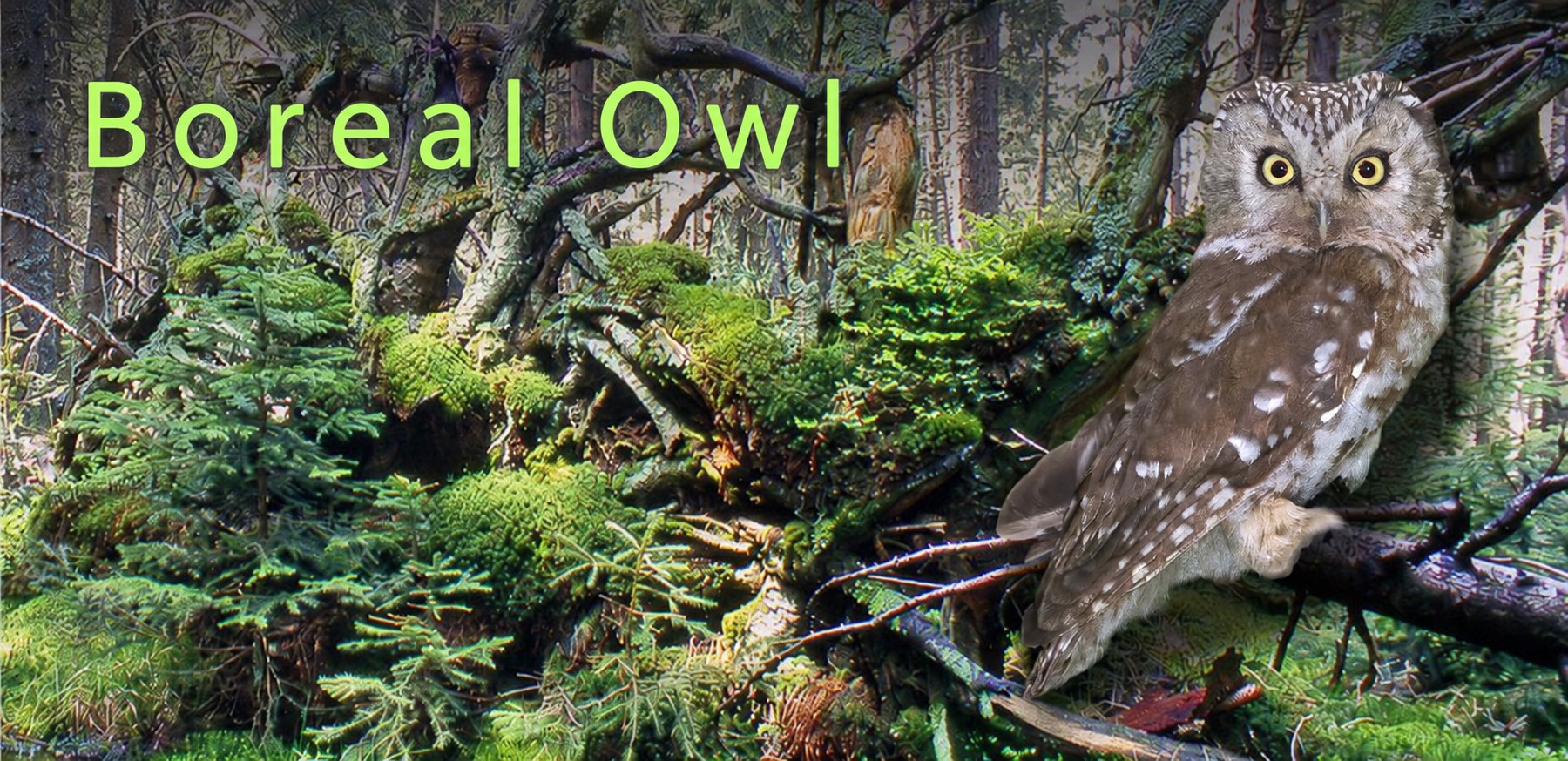


Breeding Biology of the Boreal Owl (Aegolius funereus)
Breeding populations of the Boreal Owl have been studied extensively over many years in several European countries, including Germany, Norway, Sweden and particularly Finland. Korpimäki (1986) compared data from 30 European populations monitored using comparable methods for at least four years. Based on these data, indices of population cyclicity were calculated to describe the regularity and magnitude of fluctuations in the number of breeding pairs. Across Central Europe and Fennoscandia, these indices tended to increase from south to north and from west to east (Korpimäki 1986). Within Fennoscandia, population cyclicity was more closely associated with snow cover characteristics than with geographical location alone, with higher indices recorded in areas with deeper snow cover. Deep or persistent snow cover may make it more difficult for Boreal Owls to capture small mammals moving beneath the snow, potentially affecting their foraging conditions and breeding activity (Korpimäki 1997).
The Boreal Owl is a cavity-nesting species that breeds mainly in natural tree cavities or suitable nest boxes. Pair bonds are generally not permanent, and individuals may change partners between breeding seasons. Mating takes place predominantly at night, usually on tree branches. During courtship, the male advertises and defends his breeding territory through vocalisations and attracts the female to a suitable nest cavity. The female typically lays 4–7 white eggs between late March and late May, although the timing of egg-laying and clutch size depend primarily on food availability. The female alone incubates the eggs, with incubation lasting approximately 26–29 days. As incubation usually begins after the first or second egg has been laid, hatching is asynchronous, with nestlings typically emerging at intervals of approximately two days (Hudec & Šťastný 2005).
Nestlings leave the nest cavity at approximately 27–38 days of age, with a mean of 32.4 days (Kouba et al. 2015). At this stage, they are capable of short flights, although their flight skills are not yet fully developed. Once they have left the cavity, they generally do not return to the nest. The parents, particularly the male, continue to provide food for several weeks after fledging (Hudec & Šťastný 2005).
The number of breeding pairs, the timing of breeding, clutch size and the number of fledged young are strongly influenced by food availability, particularly the abundance of small mammals. In years when small mammals are abundant, breeding activity and reproductive success may increase markedly. Conversely, in years of food scarcity, breeding may be reduced or skipped altogether. As a result, the number of breeding Boreal Owl pairs can fluctuate considerably between years in response to small-mammal population cycles (Poprach, unpublished data).
Author: Karel Poprach


Boreal Owl nestlings, Jeseníky Protected Landscape Area. Photo: © Karel Poprach.