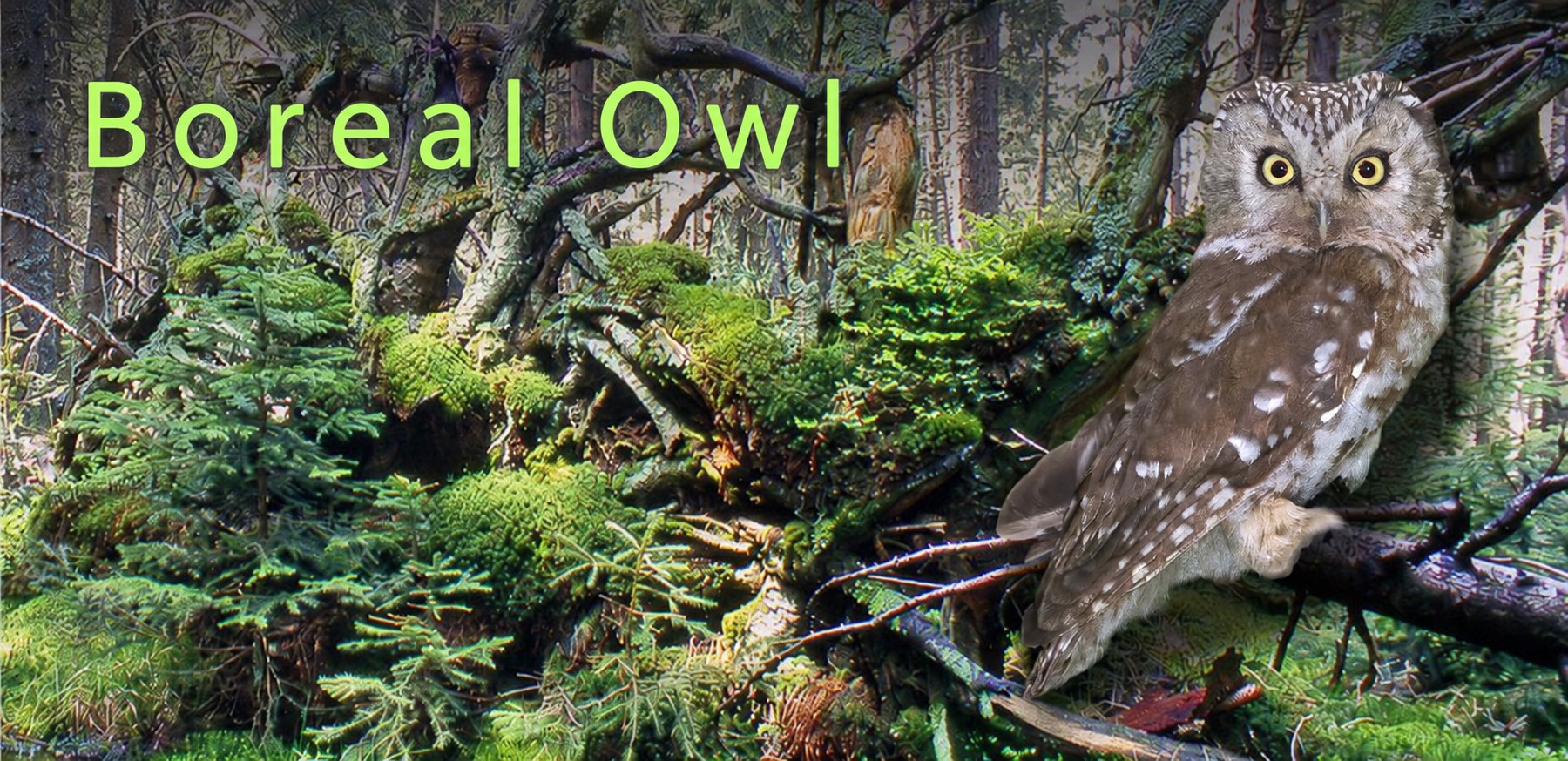


Dispersion, Migration, and Movements
Dispersion, Migration, and Movements of the Boreal Owl (Aegolius funereus)
Northern populations are described as nomadic—that is, wandering and unsettled. Males exhibit greater site fidelity to breeding grounds than females (Korpimäki 1986), although in Central Europe, breeding site fidelity has been documented in both sexes (Schwerdtfeger 1984). Nomadic females disperse annually from western Finland over distances of 500–600 km. Differences in dispersal between males and females are often linked to periodic fluctuations in prey abundance and winter food availability. Food shortages stimulate females to disperse, whereas males experience an increased need to defend their nest cavity, which reinforces their site fidelity (Korpimäki et al. 1987).
In Central Europe, adult birds are sedentary or nomadic over short distances (up to 20 km), whereas young birds tend to disperse into surrounding areas, sometimes over greater distances. However, some ringing recovery records deviate from this pattern: for example, an adult owl ringed in late August in eastern Slovakia was recaptured in October of the same year on the Baltic coast (720 km); an owl ringed in Russia in March as an adult was found in December of the same year in northern Slovakia (year of ringing and recovery not specified, author's note). By the end of 2002, a total of 26 ringing recovery records were known in the Czech Republic and Slovakia; however, all recaptures pertain to females controlled in nest boxes (Cepák et al. 2008).
Author: Karel Poprach
Distribution
Distribution of the Boreal Owl (Aegolius funereus)
The Boreal Owl (Aegolius funereus) [or Tengmalm's Owl] is a smaller owl species with predominantly nocturnal activity and a circumpolar Holarctic distribution. In Europe and North America, it mainly inhabits coniferous taiga forests (Mikkola 1983). The largest breeding populations of the Boreal Owl in Europe are found in Russia, Sweden, Finland, Belarus, and Norway. Relatively high abundance is also recorded in the Baltic states. Scattered, yet locally relatively abundant, breeding populations are also known from larger forest complexes in higher elevations of Central Europe, particularly from Austria, Germany, France, Switzerland, the Czech Republic, and Slovakia. Small local breeding populations also occur in the Netherlands, Spain, Italy, Bulgaria, and Greece. Isolated Southern European populations of the Boreal Owl are considered glacial relics whose current distribution is linked to climate changes following the end of the last ice age (Mikkola 1983, Korpimäki in Hagemeijer & Blair 1997).
Distribution of the Boreal Owl in the Czech Republic
Reports of Boreal Owl nesting date back to the 19th century, when the species was recorded as breeding in almost all border mountain ranges. However, specific nest discoveries remained relatively rare until the 1960s. Only since that period has the breeding of the Boreal Owl been confirmed across a greater number of sites in the Czech Republic (Hudec et al. 2005).
In South Bohemia, the Boreal Owl breeds at elevations ranging from 380 to 1,350 m a.s.l., though most nesting sites are situated between 700 and 1,000 m a.s.l. (Šťastný et al. 1997). Within the Czech Republic, its breeding has been confirmed mainly in the following mountain ranges: Bohemian Forest / Šumava (Kloubec 1990), Ore Mountains / Krušné hory (Drdáková 2002, Holý 2002), Jizera Mountains / Jizerské hory (Pokorný 2000), Giant Mountains / Krkonoše (Flousek 1985), Orlické Mountains / Orlické hory (Hromádko et al. 2005), Jeseníky Mountains (Suchý 2004, Poprach 2010), and the Beskids / Beskydy (Čapek 1994).
However, breeding has also been confirmed at lower elevations, for example in the Moravian Karst at 400–420 m a.s.l. (Mrlík 1994, Dvořák et al. 2002), in the Znojmo region (Tunka 1988), near Česká Třebová at 550 m a.s.l. (Tomeš 1997), in the Svitavy region (Urbánek 2001), Vyškov region (Bartl 2002), Třebíč region (Chobot J. & K. 2002), Jihlava region (Kunstmüller 2002), and Náchod region (Diviš 2004). These findings demonstrate that the breeding distribution of the Boreal Owl is not limited solely to mountain regions, but also includes suitable forest habitats in inland hilly areas (Hudec et al. 2005).
More recent atlas mapping of breeding bird distribution in the Czech Republic during 2014–2017 confirms the occurrence of the Boreal Owl primarily in mountain and submontane forest areas, as well as in certain forest complexes at lower elevations (Šťastný et al. 2021). In addition to most border mountain ranges, the species occurs, for example, in the sandstone regions of Bohemian Switzerland and Broumov, in South Bohemia, the Rokycany region, and the Bohemian-Moravian Highlands (NCA CR).
According to the latest evaluation by the NCA CR (Nature Conservation Agency of the Czech Republic), prepared as part of the reporting under Article 12 of the Birds Directive for the period 2019–2024, the breeding population of the Boreal Owl in the Czech Republic was estimated at 1,500–3,000 pairs (NCA CR 2025). Previous assessments from 2013 and 2019 reported 1,500–2,000 pairs. However, the widening of the population estimate range does not in itself demonstrate an actual increase in the species' abundance. When assessing population changes, it is also necessary to consider mapping intensity, availability of nest cavities, and interannual fluctuations in food supply.
König (1969) states that the spatial distribution of occupied nest cavities in suitable habitats is not uniform, but patchy (fragmented). This finding also corresponds with our own experiences from the Jeseníky Mountains.
Author: Karel Poprach
Interaktivní mapa lokalizovaných doupných stromů (EN)
LOKALIZACE DOUPNÝCH STROMŮ DLE PŮVODU DUTINY
{tab oba druhy}{mosmap kml='http://tyto.cz/media/kml/doupne_stromy_DUTINA_m.kml'| zoomWheel='1'}
{tab strakapoud}{mosmap kml='http://tyto.cz/media/kml/doupne_stromy_DUTINA_straka.kml'| zoomWheel='1'}
{tab datel černý}{mosmap kml='http://tyto.cz/media/kml/doupne_stromy_DUTINA_datel.kml'| zoomWheel='1'}{/tabs}
LOKALIZACE DOUPNÝCH STROMŮ DLE DRUHU STROMU S DUTINOU
{tab všechny druhy}{mosmap kml='http://tyto.cz/media/kml/doupne_stromy_STROM_m.kml'| zoomWheel='1'}
{tab topol}{mosmap kml='http://tyto.cz/media/kml/doupne_stromy_STROM_topol.kml'| zoomWheel='1'}
{tab smrk}{mosmap kml='http://tyto.cz/media/kml/doupne_stromy_STROM_smrk.kml'| zoomWheel='1'}
{tab olse}{mosmap kml='http://tyto.cz/media/kml/doupne_stromy_STROM_olse.kml'| zoomWheel='1'}
{tab modrin}{mosmap kml='http://tyto.cz/media/kml/doupne_stromy_STROM_modrin.kml'| zoomWheel='1'}
{tab jerabina}{mosmap kml='http://tyto.cz/media/kml/doupne_stromy_STROM_jarabina.kml'| zoomWheel='1'}
{tab javor}{mosmap kml='http://tyto.cz/media/kml/doupne_stromy_STROM_javor.kml'| zoomWheel='1'}
{tab jasan}{mosmap kml='http://tyto.cz/media/kml/doupne_stromy_STROM_jasan.kml'| zoomWheel='1'}
{tab dub}{mosmap kml='http://tyto.cz/media/kml/doupne_stromy_STROM_dub.kml'| zoomWheel='1'}
{tab buk}{mosmap kml='http://tyto.cz/media/kml/doupne_stromy_STROM_buk.kml'| zoomWheel='1'}
{tab briza}{mosmap kml='http://tyto.cz/media/kml/doupne_stromy_STROM_briza.kml'| zoomWheel='1'}{/tabs}
LOKALIZACE DOUPNÝCH STROMŮ DLE PROJEKTU
{tab oba projekty}{mosmap kml='http://tyto.cz/media/kml/doupne_stromy_PROJEKT_m.kml'| zoomWheel='1'}
{tab OP ŽP - Ochrana a podpora sýce rousného v Moravskoslezském kraji}{mosmap kml='http://tyto.cz/media/kml/doupne_stromy_PROJEKT_msk.kml'| zoomWheel='1'}
{tab OP ŽP - Ochrana a podpora sýce rousného v Olomouckém kraji}{mosmap kml='http://tyto.cz/media/kml/doupne_stromy_PROJEKT_olk.kml'| zoomWheel='1'}{/tabs}
Legal Protection
Legal Protection of the Boreal Owl (Aegolius funereus)
The Boreal Owl is protected in the Czech Republic under both national legislation and European Union law. Its conservation status is also assessed in scientific Red Lists of threatened species.
Protection under Czech Legislation
Under Act No. 114/1992 Coll., on Nature and Landscape Protection, as amended, and the implementing Decree No. 395/1992 Coll. of the Ministry of the Environment, the Boreal Owl is classified as a specially protected animal species in the category of strongly endangered species.
Protection under European Union Legislation
The Boreal Owl is listed in Annex I of Directive 2009/147/EC of the European Parliament and of the Council on the conservation of wild birds (Birds Directive). It is therefore among the species for which Special Protection Areas (SPAs) are designated as part of the Natura 2000 network, including selected sites in the Czech Republic.
Classification in Red Lists
In the Red Data Book of Endangered and Rare Species of Plants and Animals of Czechoslovakia, the Boreal Owl was classified as a species requiring further attention (Sedláček 1988). In the 2003 Red List of Birds of the Czech Republic, it was classified as Vulnerable (Šťastný & Bejček 2003). The species retained the same classification, Vulnerable (VU), in the more recent Red List of Birds of the Czech Republic (Šťastný et al. 2017).
Red Lists provide scientific assessments of species' extinction risk, and their categories do not necessarily correspond to the legal protection categories established under national legislation.
Author: Karel Poprach
Maps
Maps EN