

Abbreviations
The development of this website was financially supported under the project “Conservation and Support of the Boreal Owl in the Moravian-Silesian Region”, co-financed by the European Union through the European Regional Development Fund and by the State Environmental Fund of the Czech Republic under the Operational Programme Environment.

We thank the institutions listed below for their long-term financial support of the project aimed at providing nesting opportunities for the Boreal Owl in northern Moravia.
The project is implemented on land owned by the Czech Republic and managed by Lesy České republiky, s. p. (Forests of the Czech Republic), through its forest districts of Bruntál, Frenštát pod Radhoštěm, Frýdek-Místek, Hanušovice, Javorník, Jeseník, Karlovice, Loučná nad Desnou, Město Albrechtice, Ostravice, Ruda nad Moravou, Vítkov and Vsetín.


Biotope
Habitat and Breeding Requirements of the Boreal Owl (Aegolius funereus)
The Boreal Owl inhabits mainly forests at higher elevations in Central Europe, particularly coniferous forests dominated by spruce. However, it also breeds in mixed forests, including spruce stands with an admixture of pine, birch and aspen, as well as in predominantly pine forests. Breeding densities may be considerably higher in spruce-dominated forests than in pine forests. For example, in Finland, higher occupancy of breeding territories and greater nesting success have been reported in landscapes with a relatively high proportion of spruce forests and agricultural land and a low proportion of pine forests (Korpimäki 1997).
In the Czech Republic, the Boreal Owl inhabits mature forest stands, particularly spruce and mixed forests, although breeding has also been recorded in beech forests (Šťastný et al. 2006). The species has also been recorded breeding in areas affected by industrial air pollution, including forest clearings with scattered cavity-bearing trees (Šťastný et al. 2006). Its breeding distribution and the number of nesting pairs are strongly influenced by food availability, particularly the abundance of small mammals, and the availability of suitable nest cavities (Poprach, unpublished data).
Throughout much of its European range, the Boreal Owl nests primarily in cavities excavated by the Black Woodpecker (Dryocopus martius), although cavities excavated by other woodpecker species may occasionally be used. In commercially managed forests, suitable natural nest cavities may be scarce. The Boreal Owl readily occupies appropriately designed nest boxes, which can provide an important additional nesting resource in some European regions.
According to Korpimäki (1997), approximately 11,000 nest boxes had been installed for the Boreal Owl in Finland. These nest boxes substantially increased the availability of nesting sites and may have helped reduce some of the negative effects of intensive forest management on breeding opportunities. The installation and maintenance of extensive nest-box networks can therefore be an effective conservation measure in managed forests, particularly where suitable natural cavities are limited.
Author: Karel Poprach
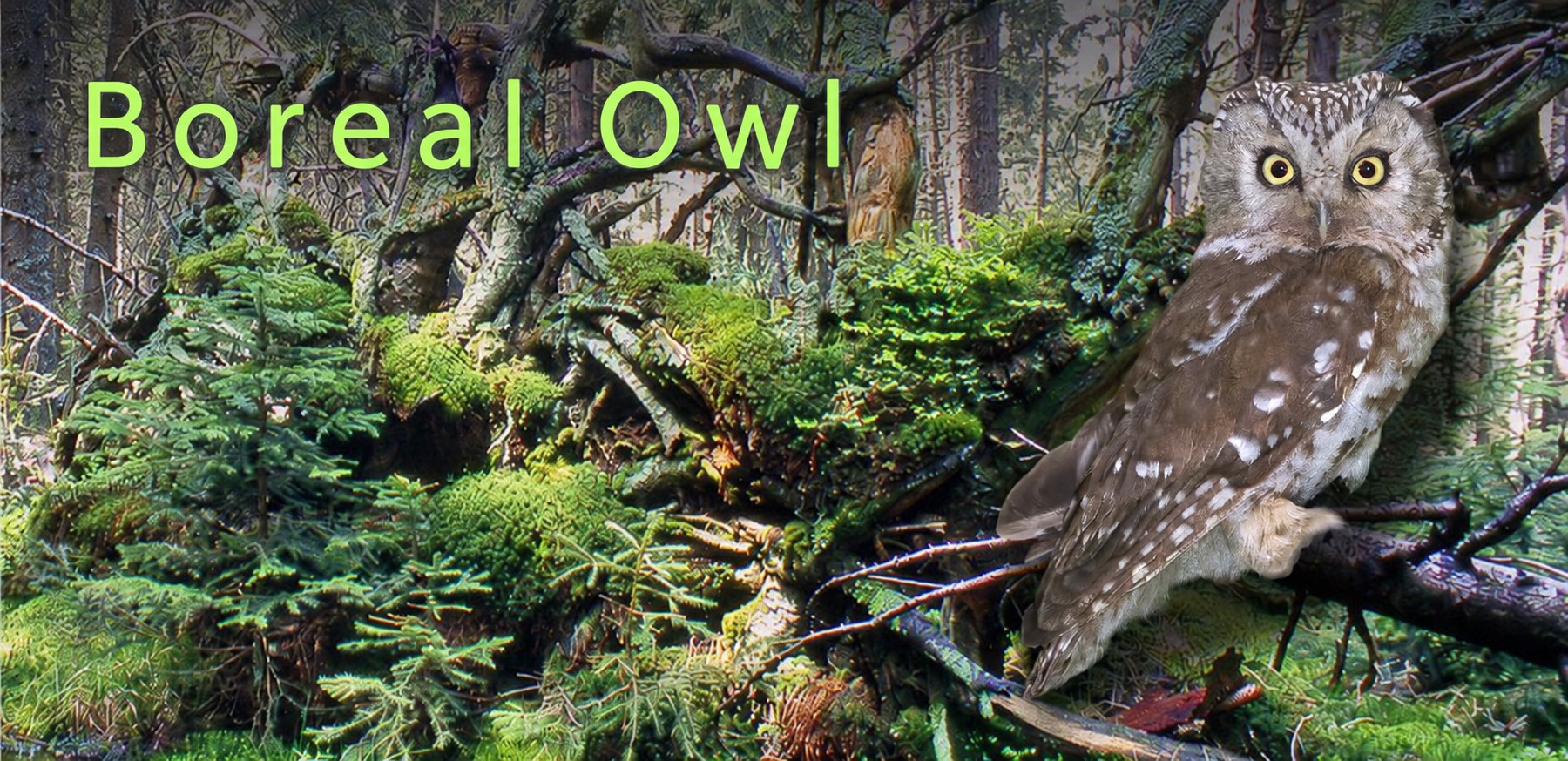
Boreal Owl
Distribution of the Boreal Owl (Aegolius funereus)
The Boreal Owl (Aegolius funereus) [or Tengmalm's Owl] is a smaller owl species with predominantly nocturnal activity and a circumpolar Holarctic distribution. In Europe and North America, it mainly inhabits coniferous taiga forests (Mikkola 1983). The largest breeding populations of the Boreal Owl in Europe are found in Russia, Sweden, Finland, Belarus, and Norway. Relatively high abundance is also recorded in the Baltic states. Scattered, yet locally relatively abundant, breeding populations are also known from larger forest complexes in higher elevations of Central Europe, particularly from Austria, Germany, France, Switzerland, the Czech Republic, and Slovakia. Small local breeding populations also occur in the Netherlands, Spain, Italy, Bulgaria, and Greece. Isolated Southern European populations of the Boreal Owl are considered glacial relics whose current distribution is linked to climate changes following the end of the last ice age (Mikkola 1983, Korpimäki in Hagemeijer & Blair 1997).
Distribution of the Boreal Owl in the Czech Republic
Reports of Boreal Owl nesting date back to the 19th century, when the species was recorded as breeding in almost all border mountain ranges. However, specific nest discoveries remained relatively rare until the 1960s. Only since that period has the breeding of the Boreal Owl been confirmed across a greater number of sites in the Czech Republic (Hudec et al. 2005).
In South Bohemia, the Boreal Owl breeds at elevations ranging from 380 to 1,350 m a.s.l., though most nesting sites are situated between 700 and 1,000 m a.s.l. (Šťastný et al. 1997). Within the Czech Republic, its breeding has been confirmed mainly in the following mountain ranges: Bohemian Forest / Šumava (Kloubec 1990), Ore Mountains / Krušné hory (Drdáková 2002, Holý 2002), Jizera Mountains / Jizerské hory (Pokorný 2000), Giant Mountains / Krkonoše (Flousek 1985), Orlické Mountains / Orlické hory (Hromádko et al. 2005), Jeseníky Mountains (Suchý 2004, Poprach 2010), and the Beskids / Beskydy (Čapek 1994).
However, breeding has also been confirmed at lower elevations, for example in the Moravian Karst at 400–420 m a.s.l. (Mrlík 1994, Dvořák et al. 2002), in the Znojmo region (Tunka 1988), near Česká Třebová at 550 m a.s.l. (Tomeš 1997), in the Svitavy region (Urbánek 2001), Vyškov region (Bartl 2002), Třebíč region (Chobot J. & K. 2002), Jihlava region (Kunstmüller 2002), and Náchod region (Diviš 2004). These findings demonstrate that the breeding distribution of the Boreal Owl is not limited solely to mountain regions, but also includes suitable forest habitats in inland hilly areas (Hudec et al. 2005).
More recent atlas mapping of breeding bird distribution in the Czech Republic during 2014–2017 confirms the occurrence of the Boreal Owl primarily in mountain and submontane forest areas, as well as in certain forest complexes at lower elevations (Šťastný et al. 2021). In addition to most border mountain ranges, the species occurs, for example, in the sandstone regions of Bohemian Switzerland and Broumov, in South Bohemia, the Rokycany region, and the Bohemian-Moravian Highlands (NCA CR).
According to the latest evaluation by the NCA CR (Nature Conservation Agency of the Czech Republic), prepared as part of the reporting under Article 12 of the Birds Directive for the period 2019–2024, the breeding population of the Boreal Owl in the Czech Republic was estimated at 1,500–3,000 pairs (NCA CR 2025). Previous assessments from 2013 and 2019 reported 1,500–2,000 pairs. However, the widening of the population estimate range does not in itself demonstrate an actual increase in the species' abundance. When assessing population changes, it is also necessary to consider mapping intensity, availability of nest cavities, and interannual fluctuations in food supply.
König (1969) states that the spatial distribution of occupied nest cavities in suitable habitats is not uniform, but patchy (fragmented). This finding also corresponds with our own experiences from the Jeseníky Mountains.
Author: Karel Poprach
Breeding Biology
Breeding Biology of the Boreal Owl (Aegolius funereus)
Breeding populations of the Boreal Owl have been studied extensively over many years in several European countries, including Germany, Norway, Sweden and particularly Finland. Korpimäki (1986) compared data from 30 European populations monitored using comparable methods for at least four years. Based on these data, indices of population cyclicity were calculated to describe the regularity and magnitude of fluctuations in the number of breeding pairs. Across Central Europe and Fennoscandia, these indices tended to increase from south to north and from west to east (Korpimäki 1986). Within Fennoscandia, population cyclicity was more closely associated with snow cover characteristics than with geographical location alone, with higher indices recorded in areas with deeper snow cover. Deep or persistent snow cover may make it more difficult for Boreal Owls to capture small mammals moving beneath the snow, potentially affecting their foraging conditions and breeding activity (Korpimäki 1997).
The Boreal Owl is a cavity-nesting species that breeds mainly in natural tree cavities or suitable nest boxes. Pair bonds are generally not permanent, and individuals may change partners between breeding seasons. Mating takes place predominantly at night, usually on tree branches. During courtship, the male advertises and defends his breeding territory through vocalisations and attracts the female to a suitable nest cavity. The female typically lays 4–7 white eggs between late March and late May, although the timing of egg-laying and clutch size depend primarily on food availability. The female alone incubates the eggs, with incubation lasting approximately 26–29 days. As incubation usually begins after the first or second egg has been laid, hatching is asynchronous, with nestlings typically emerging at intervals of approximately two days (Hudec & Šťastný 2005).
Nestlings leave the nest cavity at approximately 27–38 days of age, with a mean of 32.4 days (Kouba et al. 2015). At this stage, they are capable of short flights, although their flight skills are not yet fully developed. Once they have left the cavity, they generally do not return to the nest. The parents, particularly the male, continue to provide food for several weeks after fledging (Hudec & Šťastný 2005).
The number of breeding pairs, the timing of breeding, clutch size and the number of fledged young are strongly influenced by food availability, particularly the abundance of small mammals. In years when small mammals are abundant, breeding activity and reproductive success may increase markedly. Conversely, in years of food scarcity, breeding may be reduced or skipped altogether. As a result, the number of breeding Boreal Owl pairs can fluctuate considerably between years in response to small-mammal population cycles (Poprach, unpublished data).
Author: Karel Poprach


Boreal Owl nestlings, Jeseníky Protected Landscape Area. Photo: © Karel Poprach.
Diet
Diet of the Boreal Owl (Aegolius funereus)
Across its European distribution range, the diet of the Boreal Owl consists primarily of small mammals, particularly voles of the genus Microtus, the bank vole (Myodes glareolus), field mice of the genus Apodemus, and shrews of the genus Sorex. Small birds are also represented to a lesser extent (Korpimäki 1986). In the Fennoscandian region, vole populations exhibit marked interannual abundance fluctuations, often in 3- to 5-year cycles. The availability of this prey significantly influences the breeding density and reproductive success of the Boreal Owl, with the nature of population fluctuations varying depending on geographic location and local ecological conditions (Korpimäki 1986).
In the Czech Republic, the Boreal Owl's diet mainly comprises the field vole (Microtus agrestis), common vole (Microtus arvalis), bank vole (Myodes glareolus), yellow-necked mouse (Apodemus flavicollis), and wood mouse (Apodemus sylvaticus). Other species recorded in the diet include the hazel dormouse (Muscardinus avellanarius), Eurasian Pygmy Shrew / Common Shrew (Sorex araneus), Eurasian Pygmy Shrew (Sorex minutus), Alpine shrew (Sorex alpinus), and white-toothed shrews of the genus Crocidura. Small birds are also represented to a lesser extent (Vacík 1991, Hudec & Šťastný 2005).
The Boreal Owl is heavily dependent on the availability of small mammals. In years of low rodent numbers, breeding activity may be reduced, clutch size and nesting success lowered, or breeding skipped altogether. Conversely, in years with high small mammal density, both the number of breeding pairs and reproductive success tend to be higher (Poprach unpubl.).
Author: Karel Poprach


During years of high small mammal abundance, food caches containing more than ten prey individuals can sometimes be found in Boreal Owl nest boxes. Photo: © Karel Poprach.